These flyers may be printed and shared freely, unaltered and with attribution. Not for resale or modification.
© 2026 Rebecca Koré · Brújula Press
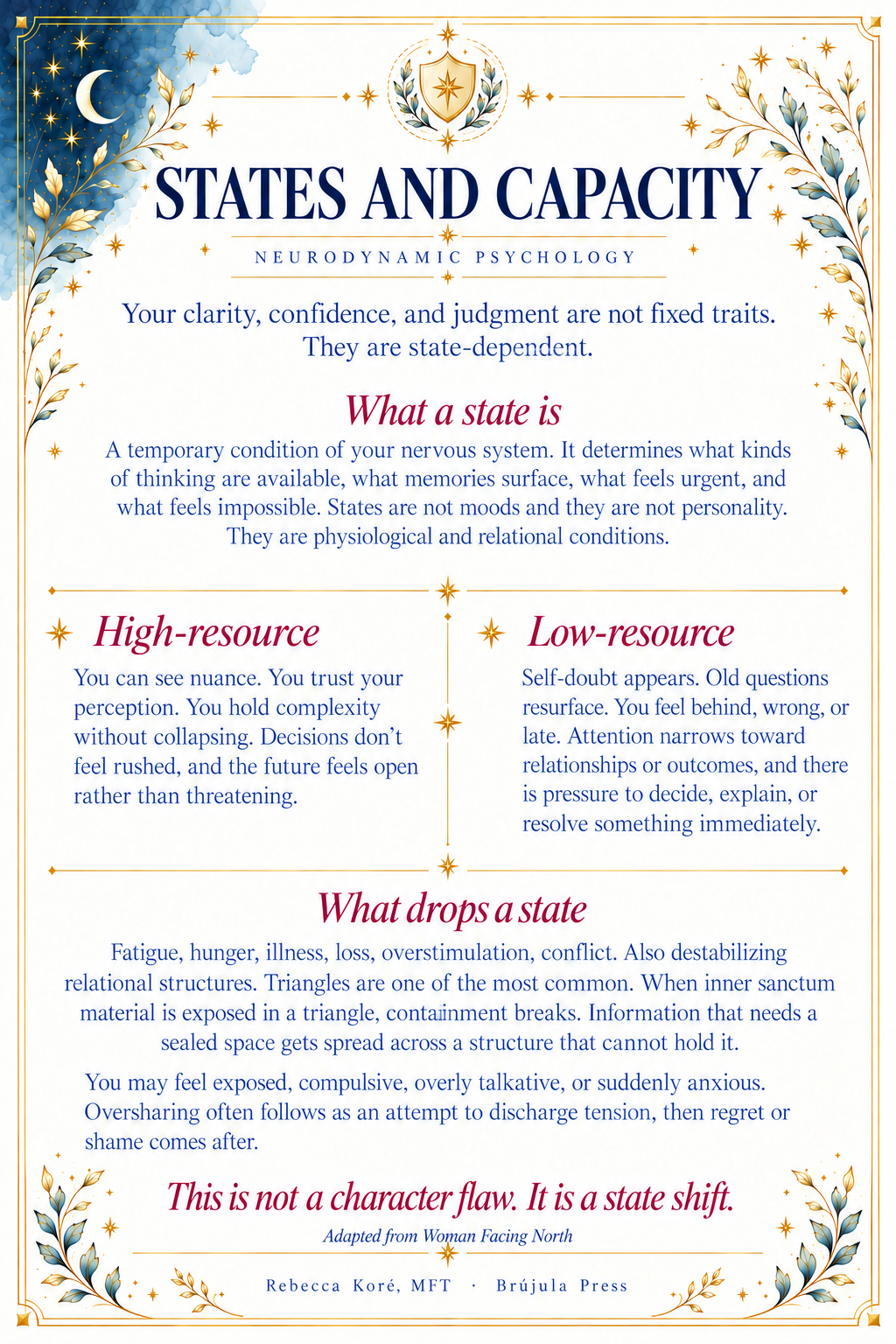
Neurodynamic Psychology
States and Capacity
Adapted from Woman Facing North
Your clarity, confidence, and judgment are not fixed traits. They are state-dependent.
What a state is
A temporary condition of your nervous system. It determines what kinds of thinking are available, what memories surface, what feels urgent, and what feels impossible. States are not moods and they are not personality. They are physiological and relational conditions.
High-resource
You can see nuance. You trust your perception. You hold complexity without collapsing. Decisions don't feel rushed, and the future feels open rather than threatening.
Low-resource
Self-doubt appears. Old questions resurface. You feel behind, wrong, or late. Attention narrows toward relationships or outcomes, and there is pressure to decide, explain, or resolve something immediately.
What drops a state
Fatigue, hunger, illness, loss, overstimulation, conflict. Also destabilizing relational structures. Triangles are one of the most common. When inner sanctum material is exposed in a triangle, containment breaks. Information that needs a sealed space gets spread across a structure that cannot hold it.
You may feel exposed, compulsive, overly talkative, or suddenly anxious. Oversharing often follows as an attempt to discharge tension, then regret or shame comes after.
This is not a character flaw. It is a state shift.
These flyers may be printed and shared freely, unaltered and with attribution. Not for resale or modification.
© 2026 Rebecca Koré · Brújula Press
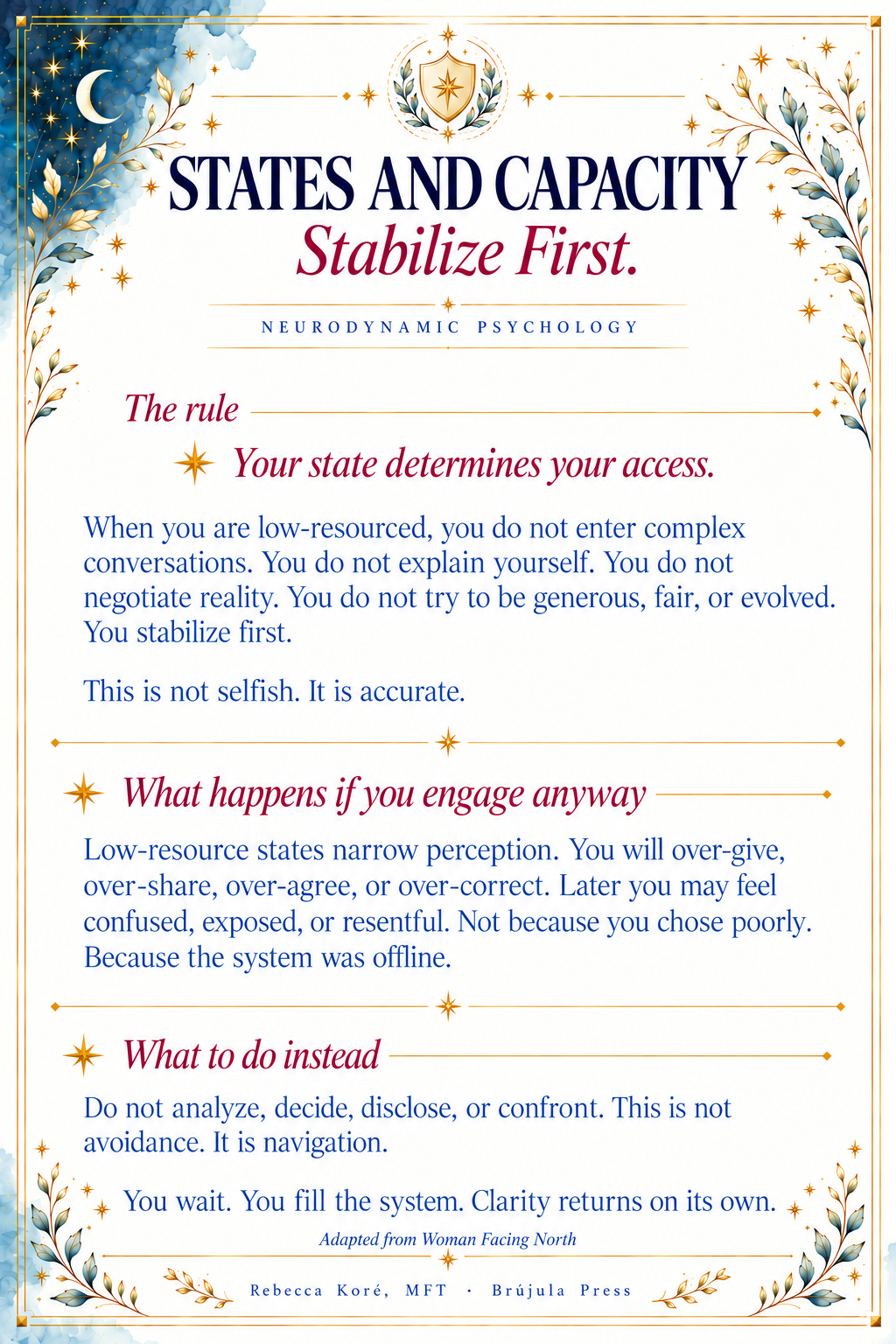
Neurodynamic Psychology
States and Capacity
Stabilize First
Adapted from Woman Facing North
The rule
Your state determines your access.
When you are low-resourced, you do not enter complex conversations. You do not explain yourself. You do not negotiate reality. You do not try to be generous, fair, or evolved. You stabilize first.
This is not selfish. It is accurate.
What happens if you engage anyway
Low-resource states narrow perception. You will over-give, over-share, over-agree, or over-correct. Later you may feel confused, exposed, or resentful. Not because you chose poorly. Because the system was offline.
What to do instead
Do not analyze, decide, disclose, or confront. This is not avoidance. It is navigation.
You wait. You fill the system. Clarity returns on its own.