These flyers may be printed and shared freely, unaltered and with attribution. Not for resale or modification.
© 2026 Rebecca Koré · Brújula Press
Neurodynamic Psychology
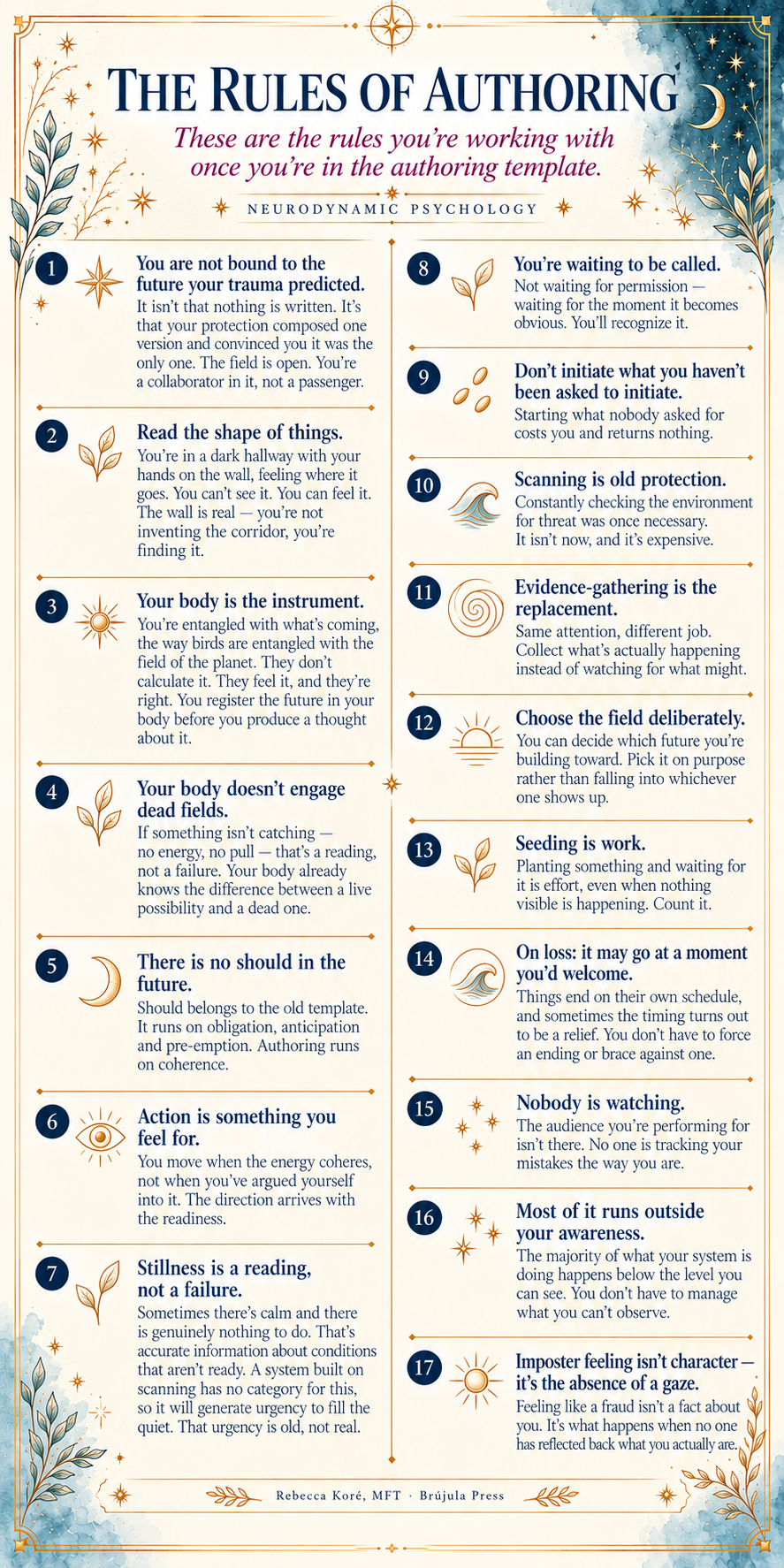
The Rules of Authoring
These are the rules you're working with once you're in the authoring template.
You are not bound to the future your trauma predicted.
It isn't that nothing is written. It's that your protection composed one version and convinced you it was the only one. The field is open. You're a collaborator in it, not a passenger.
Read the shape of things.
You're in a dark hallway with your hands on the wall, feeling where it goes. You can't see it. You can feel it. The wall is real. You're not inventing the corridor, you're finding it.
Your body is the instrument.
You're entangled with what's coming, the way birds are entangled with the field of the planet. They don't calculate it. They feel it, and they're right. You register the future in your body before you produce a thought about it.
Your body doesn't engage dead fields.
If something isn't catching — no energy, no pull — that's a reading, not a failure. Your body already knows the difference between a live possibility and a dead one.
There is no should in the future.
Should belongs to the old template. It runs on obligation, anticipation and pre-emption. Authoring runs on coherence.
Action is something you feel for.
You move when the energy coheres, not when you've argued yourself into it. The direction arrives with the readiness.
Stillness is a reading, not a failure.
Sometimes there's calm and there is genuinely nothing to do. That's accurate information about conditions that aren't ready. A system built on scanning has no category for this, so it will generate urgency to fill the quiet. That urgency is old, not real.
You're waiting to be called.
Not waiting for permission, waiting for the moment it becomes obvious. You'll recognize it.
Don't initiate what you haven't been asked to initiate.
Starting what nobody asked for costs you and returns nothing.
Scanning is old protection.
Constantly checking the environment for threat was once necessary. It isn't now, and it's expensive.
Evidence-gathering is the replacement.
Same attention, different job. Collect what's actually happening instead of watching for what might.
Choose the field deliberately.
You can decide which future you're building toward. Pick it on purpose rather than falling into whichever one shows up.
Seeding is work.
Planting something and waiting for it is effort, even when nothing visible is happening. Count it.
On loss: it may go at a moment you'd welcome.
Things end on their own schedule, and sometimes the timing turns out to be a relief. You don't have to force an ending or brace against one.
Nobody is watching.
The audience you're performing for isn't there. No one is tracking your mistakes the way you are.
Most of it runs outside your awareness.
The majority of what your system is doing happens below the level you can see. You don't have to manage what you can't observe.
Imposter feeling isn't character. It's the absence of a gaze.
Feeling like a fraud isn't a fact about you. It's what happens when no one has reflected back what you actually are.