These flyers may be printed and shared freely, unaltered and with attribution. Not for resale or modification.
© 2026 Rebecca Koré · Brújula Press
Neurodynamic Psychology
Node Reconnection
A Clinical Abstract
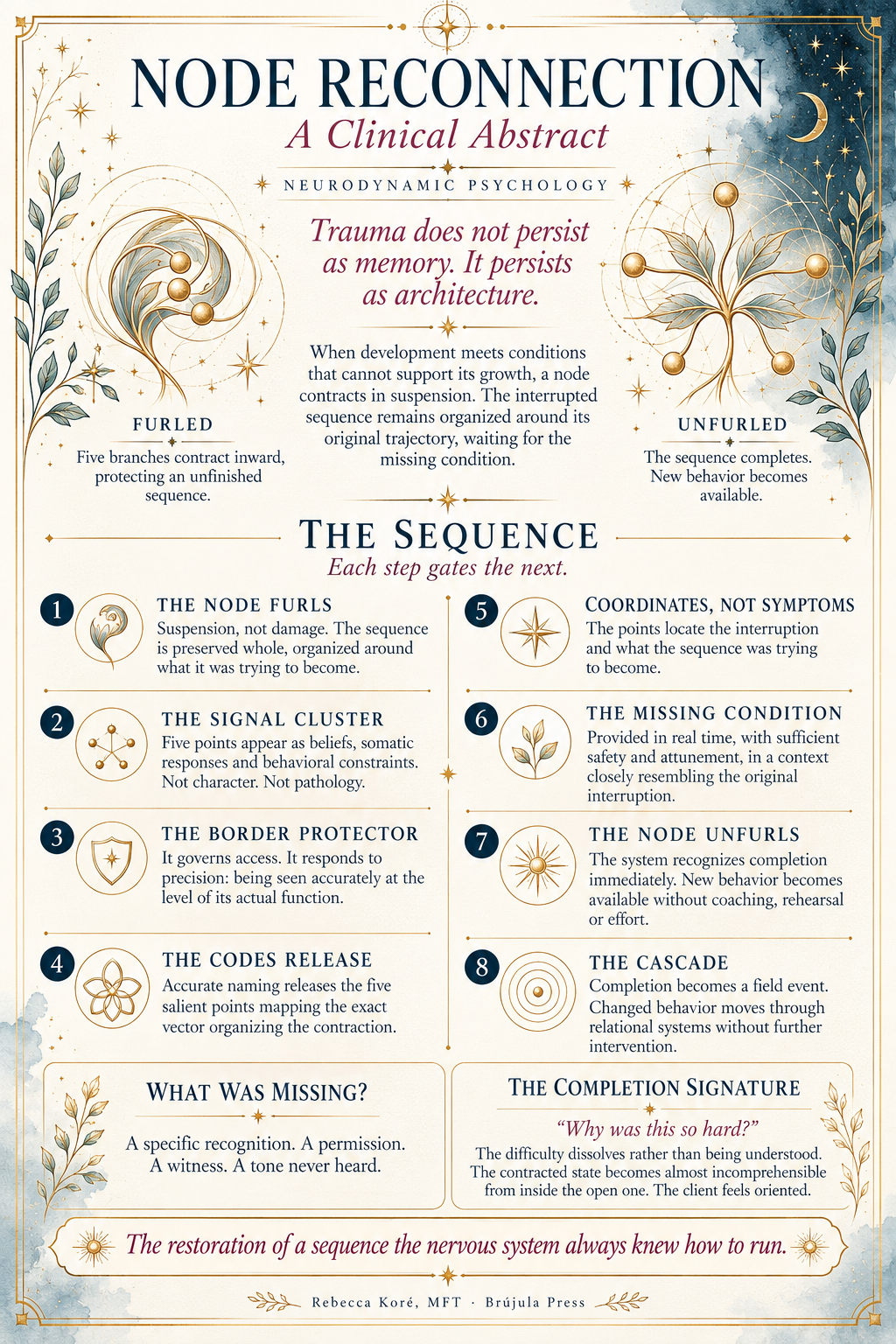
Trauma does not persist as memory. It persists as architecture.
When a developing nervous system meets conditions that cannot support its intended growth, specific neural nodes shut down, not in damage, but in suspension. The interrupted sequence remains intact, organized around its original trajectory, waiting for the conditions that will let it complete.
The two states
Furled: five branches contracted inward, protecting an unfinished sequence from premature or unsafe activation.
Unfurled: the sequence completes, and new behavior becomes available without coaching, rehearsal or effort.
What moves the node from one state to the other is the missing condition.
The sequence, in order
Each step gates the next.
The node furls.
Suspension, not damage. The sequence is preserved whole, still organized around what it was trying to become.
It presents as a five-point signal cluster.
Beliefs, somatic responses and behavioral constraints that look entrenched. Not character. Not pathology.
The Border Protector governs access.
It does not respond to reassurance or warmth alone. It responds to precision, to being seen accurately at the level of its actual function.
Named accurately, it releases the codes:
the five salient points that map the exact vector organizing the contraction.
The five points are coordinates, not symptoms.
They indicate where the sequence was interrupted, and what it was trying to become.
The missing condition is provided.
In real time, inside a field of sufficient safety and attunement, in a context that closely resembles the original interruption.
The node unfurls.
The system recognizes it immediately. New behavior becomes available with no coaching, rehearsal or effort.
It cascades.
Completion is not an individual event but a field event. The reconnected node changes behavior in the wild and moves through relational systems without further intervention.
What was missing is rarely complex: a specific recognition that never arrived, a permission not given, a witness who never showed up, a tone never heard.
The completion signature is this question: why was this so hard? The difficulty dissolves rather than being understood. The contracted state becomes almost incomprehensible from inside the open one. The client does not feel relieved. They feel oriented.
This is not insight, reframing, symptom management or technique. It is the restoration of a sequence the nervous system always knew how to run.